
Guide
Polished concrete floor care: service life and cleaning schedule
Polished concrete has no wax to strip and no coating to peel, which is why so many stores, schools and offices now leave the slab as the finished floor. It still needs care. The gloss lives in the top of the ground surface and in a thin guard, and grit, harsh chemistry and skipped burnishing wear both away. This guide explains the floor, its life span, where it is used and the schedule that keeps it bright.
Request a quoteCall (408) 533-0557
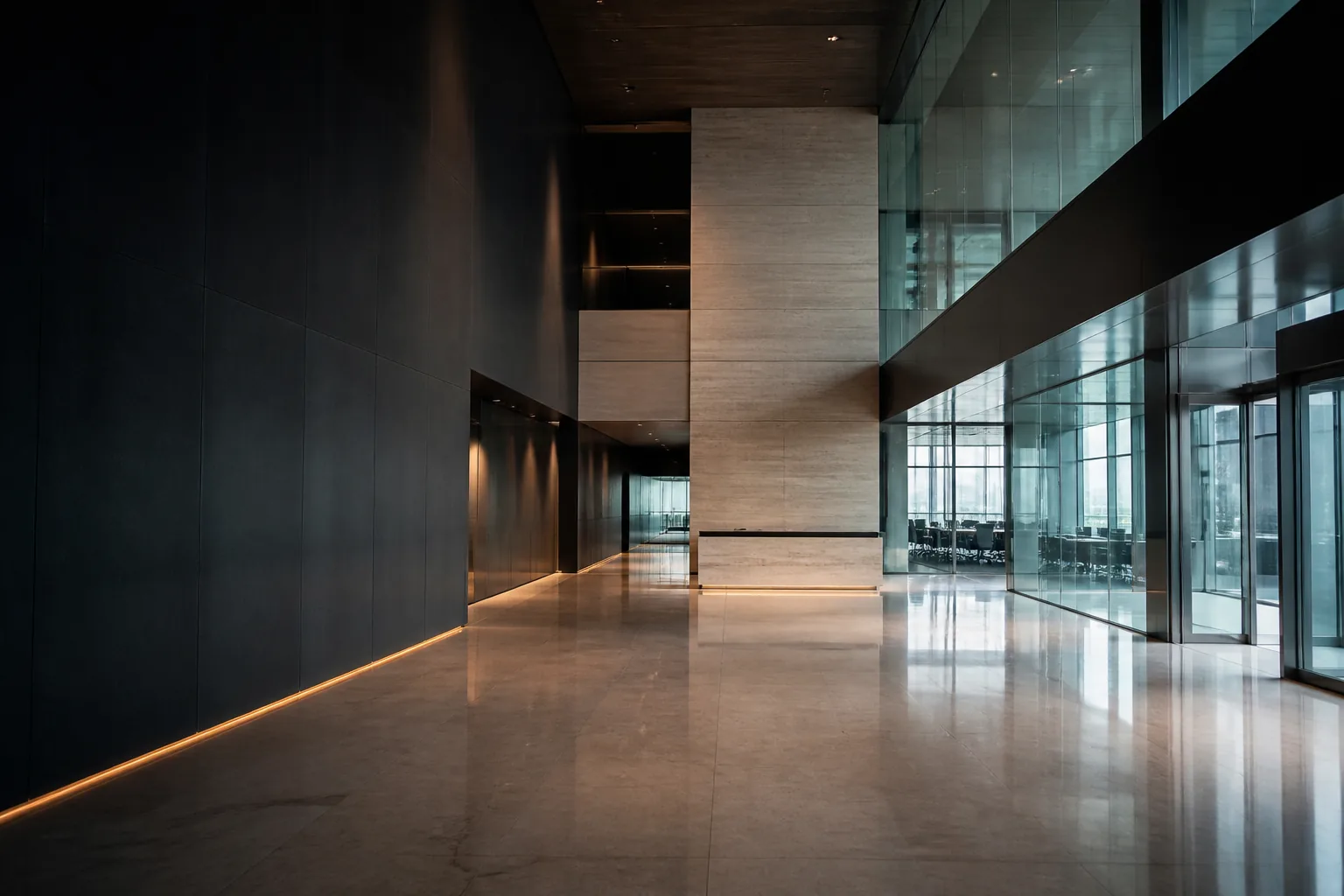
What polished concrete is
Polished concrete starts as an ordinary structural slab. A polishing contractor grinds the top with metal-bonded diamond tooling to open the surface, then works up through resin-bonded diamonds of ever finer grit until the scratches become too small to scatter light. The deeper the first grind, the more sand and stone shows, from a plain cream finish to salt-and-pepper speckle to fully exposed aggregate.
Partway through the grind, the crew applies a densifier, a lithium, sodium or potassium silicate solution. It reacts with free lime in the cement paste and forms extra hard crystals inside the pores, so the surface resists dusting and takes a sharper polish. Most commercial installations finish with a guard, a very thin stain-resistant treatment that sits in and on the polished face.
Two things carry the look, and routine care exists to protect both. The first is the refined surface of the concrete itself, which dulls as shoes, cart wheels and grit leave fine scratches. The second is the guard, which is sacrificial: traffic walks it off a little at a time, and stains reach the slab once it is gone.
The Concrete Polishing Association of America separates three methods. Bonded abrasive polishing cuts the gloss into the concrete with diamonds and needs the least upkeep. Burnished polishing builds shine mostly with high-speed pads and products, and hybrid systems mix the two. The method on a given floor sets how much burnishing and guard renewal it takes to hold its appearance.
How long polished concrete lasts
The slab is part of the building. Prosoco, a maker of densifiers and guards, writes that with the right maintenance plan a finished concrete floor can last the life of the building it sits in. Nobody pulls up a polished slab because it wore out; what wears is the polished face and the guard on top of it.
For the polished surface, trade guidance puts a light re-polish with fine-grit diamonds at roughly ten to fifteen years in steady commercial use, earlier in grocery aisles and later in a quiet office. The guard runs on a much shorter clock. Bomanite’s suggested schedule for its polished systems calls for a yearly review of gloss and staining, with a fresh stain-resistant treatment applied where the floor needs it.
The factors that move a floor along those ranges are well known:
- Wheel traffic. Shopping carts, pallet jacks and stocking carts dull a floor faster than foot traffic, and aisles fade before the edges of the room.
- Grit at the doors. Sand carried in on shoes acts like loose sandpaper on the first stretch of floor inside every entrance.
- Matting. Scraper and wiper mats at the doors catch most of that grit before it reaches the sales floor.
- Cleaning chemistry. Neutral cleaners leave the guard and the paste alone, while acids etch the cement and strong alkalis break down the guard.
- Burnishing on time. Regular high-speed burnishing with diamond-impregnated pads removes light scratches before they add up to a dull lane.
- Polishing method. A floor polished deep with bonded abrasives holds its gloss longer than one that leans on burnished-in products.
Re-grinding, re-densifying and reapplying the guard belong to a concrete polishing contractor, booked on that contractor’s schedule. A floor that is cleaned and burnished on time simply needs that visit less often.
Where facilities use polished concrete
Polished concrete fits wherever a building wants a bright, hard-wearing floor without a finish program. The rooms that get it vary by building type:
- Big-box and grocery retail: sales floors, checkout lanes, garden centers and the stockroom behind them, planned through shopping center and retail floor care.
- Offices: lobbies, open work areas, cafes and creative studios, covered by office floor care.
- Schools and colleges: main corridors, commons, cafeterias and newer classroom wings, part of school floor care.
- Car dealerships: showroom floors where vehicles sit under bright lights, with service drives nearby, through dealership and showroom floor care.
- Warehouses and light industrial: office fronts, will-call counters and clean assembly areas, listed under industrial and warehouse floor care.
- Restaurants: dining rooms and order counters in fast-casual and brewpub spaces, with restaurant floor care covering the kitchen.
- Event venues and churches: exhibit halls, foyers and fellowship halls, through event venue floor care and church floor care.
- Hotels and clinics: modern lobbies and waiting rooms, part of hotel floor care and medical facility floor care.
Inside a building, polished concrete tends to cover the large, open, high-traffic areas, while restrooms, kitchens and wet rooms usually carry tile and private offices keep carpet.
Why facilities choose it
The biggest draw is the absence of a coating. A polished slab has no floor finish to scrub and recoat or strip and rebuild, so the yearly strip-and-wax cycle that resilient tile needs simply goes away. Prosoco, which makes densifiers and guards, says finished concrete costs two to three times less to maintain than other flooring.
Durability comes next. Densified, polished concrete stands up to cart wheels, pallet jacks and rolling displays that scuff and cut through a soft finish. With no covering, there are no seams to lift, no adhesive to fail and no tiles to replace after a dropped load.
Light is a quieter benefit. A polished floor reflects overhead light back into the room, which brightens aisles and showrooms. Densifying also stops the grey dust a bare slab sheds, so less of it settles on stock, shelving and equipment.
Clean polished concrete has good traction. Bomanite reports independent testing that rated its polished systems as high-traction under ANSI B101.1. That traction drops when the floor carries dust, standing water or a wax someone added, so dust control and fast spill pickup matter. The slip resistance guide covers wet-floor practice.
Finally, a slab with no finish program means fewer chemicals over its life: no stripper, no coats of finish and none of the odor and closures that come with them.
The care schedule, from daily to yearly
Traffic sets the pace. Heavy floors are grocery and big-box sales floors, checkout lanes and school commons. Moderate floors are office lobbies, school corridors and restaurant dining rooms. Light floors are showrooms between events, conference areas and quiet back offices. Each interval below notes how those tiers shift it.
Daily
- Dust mop. Run a clean, dry microfiber or untreated dust mop over the traffic areas. Oil-treated mops leave a film that dulls the shine and holds dirt.
- Spills. Wipe up coffee, soda, juice, wine and oil as soon as they land, using water or a neutral cleaner. Acidic and oily spills mark the slab once they sit.
- Mats. Vacuum or shake out entrance mats and straighten any that have curled.
- Heavy traffic. Auto-scrub the sales floor nightly with a neutral cleaner and a soft pad or a fine diamond maintenance pad, picking up the solution in the same pass.
Weekly
- Full scrub. Auto-scrub the whole floor with a neutral cleaner on moderate traffic, two or three times a week on busier floors and once a week on light ones.
- Edges and corners. Work along walls, under fixtures and around columns with a small scrubber or by hand, since grit and haze collect where the large machine misses.
- Aisle burnish. On heavy floors, dry burnish the main aisles and the area inside each entrance with a high-speed burnisher and a fine diamond-impregnated pad.
Monthly
- High-speed burnishing. Burnish the full floor with diamond-impregnated pads. Bomanite suggests a 400-grit pad for a standard gloss and 1,500 followed by 3,000 grit for a high-gloss floor.
- Gloss walk. Compare the shine in the busiest lanes with the edges of the room, and note any new etch marks or stains.
- Light floors. For showrooms and quiet areas, the monthly burnish can drop to once a quarter.
Quarterly or twice a year
- Diamond-pad restoration. Where lanes have dulled, scrub them repeatedly with diamond maintenance pads, often across seven to ten cleaning cycles, until the gloss comes back, then return to the usual pad.
- Move-out clean. Clear movable fixtures, displays and furniture zone by zone and scrub and burnish beneath them.
- Matting review. Replace mats that have flattened or stopped trapping grit.
- Heavy floors. Grocery and big-box floors run this restoration step every quarter; offices and schools need it twice a year.
Yearly or restorative
- Condition review. Walk the floor once a year with the facility contact and note where stains now soak in, where scratches no longer burnish out and where the gloss has faded.
- Specialist handoff. When the guard is gone or the surface has lost its cut, the facility books its concrete polishing contractor to reapply the guard, re-densify or regrind with fine diamonds.
- School summer and store resets. Line up deep scrubbing and burnishing with summer breaks, remodels or fixture resets, when the floor is open.
A grocery store pulls every interval forward, while a polished office lobby with light traffic can run on the moderate rhythm all year. The floor cleaning frequency guide compares these rhythms with other floors.
Habits that wear polished concrete out early
Polished concrete forgives a lot, but a handful of habits strip away its shine quickly:
- Acids and strong alkalis. Vinegar, descalers, citrus cleaners and heavy degreasers etch the paste or break down the guard. Prosoco tells owners never to use acidic or alkaline cleaners on its floors.
- Adding wax or floor finish. Coating a polished slab turns it into a waxed floor that scuffs, yellows and has to be stripped, and it hides the polish underneath.
- Aggressive pads and stiff brushes. Black or brown stripping pads and stiff cylindrical brushes scratch the refined surface.
- Dirty mop water and residue. Cleaner left to dry on the floor leaves a dull film that reads as lost gloss.
- Grit and missing mats. Sand tracked across the floor between scrubs keeps cutting new scratches.
- Standing moisture. Plant pots, wet boxes and floor mats left damp mark the surface underneath them.
- Dragging loads. Fixtures, pallets and steel-legged furniture dragged across the floor gouge it. Felt pads under chair legs help.
Signs it needs more than routine care
Routine scrubbing and burnishing keep a sound polished floor looking right. These signs mean the surface itself has changed:
- Spills darken the floor within minutes instead of sitting on top.
- Traffic lanes stay dull after a diamond-pad scrub and a burnish.
- Etch rings from drinks or cleaners show as dull spots in otherwise bright areas.
- Scratches from carts or fixtures catch a fingernail.
- Fine grey dust returns on shelving, a sign that the densified surface has worn through.
- Joint filler has pulled away or cracks are spreading.
- A cloudy, slick film points to a wax or coating someone added.
More frequent burnishing or diamond-pad restoration answers some of these. Others, such as a worn-off guard, deep scratches, dusting and joint repair, are work for a concrete polishing or coatings contractor, and a clean floor shows that contractor exactly where the damage is.
How Solum helps
Solum auto-scrubs polished concrete with neutral cleaners and runs high-speed diamond-pad burnishing on the schedule above through its concrete floor scrubbing service. The burnishing guide explains pads and speeds, the auto-scrubber guide covers the machines, sealed concrete care covers unpolished slabs and the floor care cost guide lays out what drives pricing.
A few useful answers
Quick answers.
Does polished concrete need wax or floor finish?
No. The shine comes from the ground and densified surface and its guard. Wax or finish on top creates a coating that scuffs and must be stripped, and it hides the polish.
What cleaner should be used on polished concrete?
A neutral cleaner made for polished concrete or stone, mixed at the label rate. Acids etch the cement paste and strong alkaline degreasers break down the guard.
How often should a polished concrete floor be burnished?
Busy retail floors get their main aisles burnished weekly and the whole floor monthly. Office lobbies and school corridors do well with a monthly burnish, and quiet showrooms with a quarterly one.
Why has my polished concrete lost its shine in the aisles?
Fine scratches from shoes, carts and grit dull the busiest lanes first. Repeated scrubbing with diamond maintenance pads followed by burnishing usually brings that gloss back.
What is a guard on polished concrete?
A very thin stain-resistant treatment applied at the end of polishing. Traffic wears it away over time, so a polishing contractor reapplies it when spills start soaking in.
Who regrinds or re-guards a polished concrete floor?
A concrete polishing or coatings contractor, on its own schedule. Solum keeps the floor clean and burnished before and after that work.
Is polished concrete slippery?
Clean, dry polished concrete has good traction. Dust, water and any wax added on top lower it, so dust mopping, fast spill pickup and wet-floor signs matter most.
Services