
Guide
Restaurant kitchen floor degreasing: a plan for the line and dish area
In a busy Sacramento grill or a Fresno taqueria, grease reaches the floor every service: fryer splatter, drips under the hood line and rinse water carried out of the dish pit on every shoe. This guide lays out a degreasing plan that keeps that film from building, night by night and season by season.
Request a quoteCall (408) 533-0557
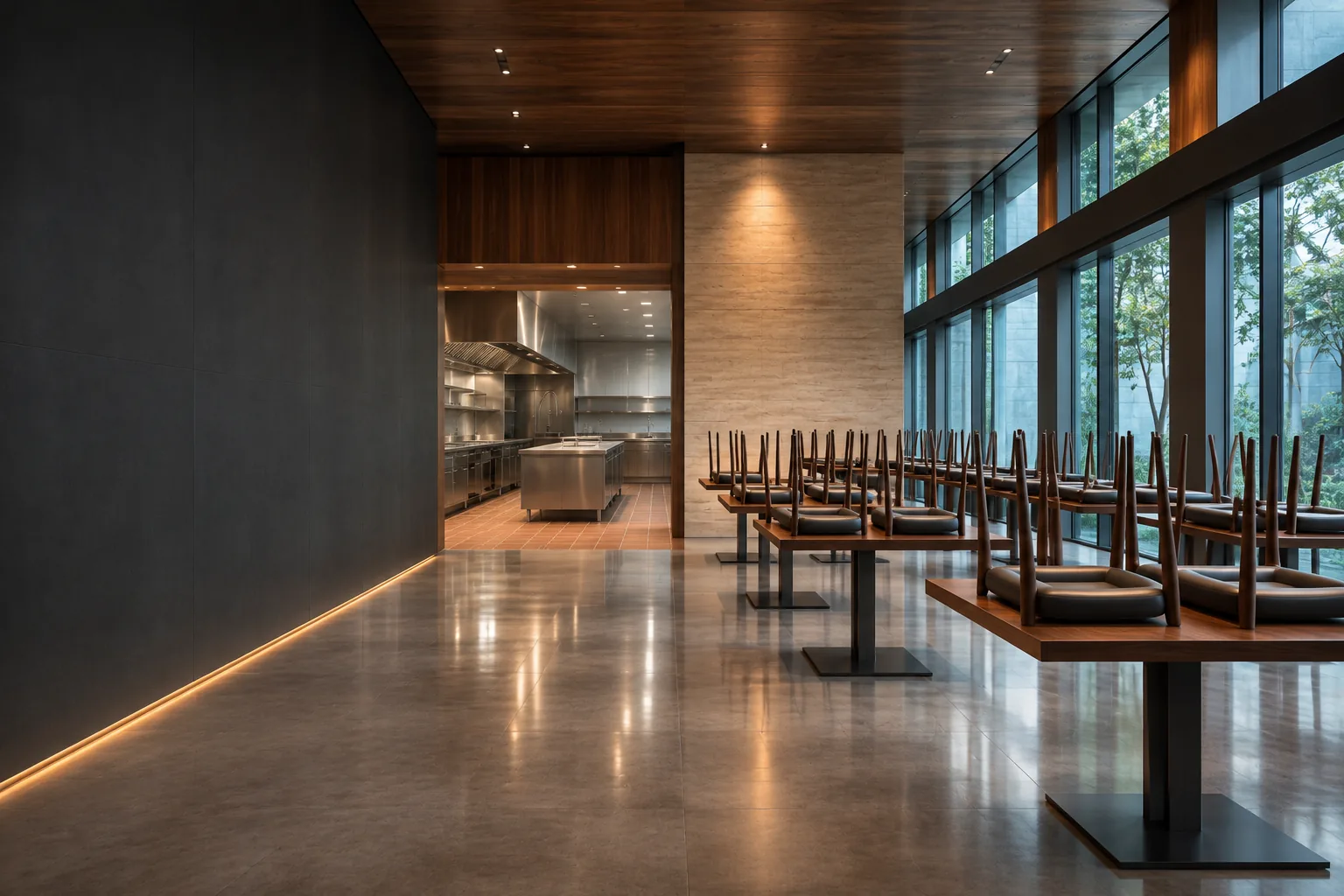
Map where grease lands
Grease never spreads evenly across a kitchen floor. It gathers in front of the fryers and flat-top, under the hood line where condensate drips, around the prep sinks and in the dish area, where scraps, detergent and hot water meet. A second band follows the route from the line to the walk-in and out the back door, where every trip leaves a little more film from shoe soles.
Walk the kitchen after a dinner rush and note where shoes stick and where the floor looks dark and glossy instead of clean. Those spots set the order of every degreasing pass. Note the surface too: quarry tile, glazed ceramic, sealed concrete and resilient sheet each hold grease differently, and quarry tile, the most common of them, hides film in its texture until the grout gives it away.
Add the places that are easy to skip: under equipment on casters, behind the ice machine, the toe-kick below the line and the threshold of the walk-in cooler. Grease that settles there hardens and slowly works its way back onto the main floor.
The nightly degreasing routine
The kitchen team’s closing routine carries most of the load. Scrape and wipe up heavy grease and food solids first so they go into the trash rather than down the drain. Then sweep, apply a degreaser suited to the floor at the strength its label calls for, and give it enough dwell time to loosen the film before anyone starts scrubbing.
Agitation is what lifts grease out of texture and grout. A stiff deck brush or a floor machine works the solution into the surface, while a string mop alone tends to spread the film thinner without removing it. Squeegee the loosened soil toward the floor drains or pick it up with a wet vacuum, then rinse with clean water so no detergent is left behind to grab tomorrow’s soil.
Rinsing is the step most often cut short at the end of a long night, and the floor shows it. A kitchen floor that dries with degreaser still on it turns tacky, gathers dust before morning and feels slick the moment the first spill lands. Fresh rinse water and a last squeegee pass prevent that.
Weekly detail work in the dish area and corners
Once a week, go further than the nightly pass. Roll out the equipment that moves, degrease the floor beneath it and along the wall base, and work the corners a mop never reaches. The dish area earns its own attention: the floor around the machine and the pre-rinse station stays wet for hours, and soap scum combines with grease into a film that ordinary mopping leaves in place.
Check the floor drains and their grates the same night. Debris caught in a grate holds standing water around it, and that wet ring becomes the darkest patch in the room. Keep the area around floor sinks clear so rinse water drains away instead of pooling.
Periodic deep scrubbing and grout work
Even a disciplined nightly routine leaves a thin residue in grout joints and textured surfaces. Over months the grout turns from grey to brown to black, and the floor never looks clean even right after mopping. That is the signal for a periodic deep scrub with machine brushes chosen for the surface, followed by a thorough rinse and pickup.
On tile floors, tile and grout cleaning goes straight at the joints, which is where kitchen floors lose most of their looks. Sealed concrete in back-of-house rooms gets scrubbing matched to its coating. The material and its condition are assessed on a walkthrough before any method is picked, because chemistry strong enough for unsealed quarry tile can harm a different surface.
How often that deep work comes around follows the menu and the covers. A kitchen built around fryers and a charbroiler reaches that point far sooner than a café that mostly bakes and assembles. Let the grout color and the feel of the floor after the nightly clean set the interval.
Fitting the work between close and prep
Kitchen floors have one real window: after the last pan is washed and before the morning crew walks in. Deep scrubbing fits that gap as long as the floor has time to dry before prep begins, so plan it for a night the kitchen closes early or the day the restaurant is dark each week.
Split a large kitchen into sections when the window is short. The dish area and back door can be done one night and the cook line another, so prep is never blocked. Restaurant and food-service floor care can bring the dining room floors into the same inquiry, with price and timing settled before any deep work starts.
Outside the back door, grease rides in on shoes from the dumpster enclosure and the used-oil bin. Pressure washing that pad and the rear walkway removes a source of film that would otherwise track back into the kitchen, and the guide to entries and dumpster pads covers that exterior work.
A few useful answers
Quick answers.
What degreasing frequency suits a busy kitchen floor?
Every night for the line, dish area and back-door route, with weekly detail work under equipment and a periodic deep scrub once the grout starts to darken.
Why does a kitchen floor feel slippery right after mopping?
Degreaser residue or grease spread thin by the mop is the usual cause. Agitating the solution, picking it up and rinsing with clean water leaves far less film behind.
Which degreaser belongs on a commercial kitchen floor?
One made for the floor material, mixed at the strength on its label. Quarry tile, glazed tile, sealed concrete and resilient sheet each tolerate different chemistry, so the surface is identified first.
When should a restaurant kitchen floor get a deep scrub?
After close on a night before a late opening, or on the restaurant’s dark day, so the floor dries fully before prep.
Industries
Related industries
Services