
Guide
Food facility floors under the California Retail Food Code
For a Hayward restaurant, a Clovis school kitchen or a Sacramento grocery deli, the floor is one of the first surfaces a health inspector reads. This guide sets out what the California Retail Food Code says about food facility floors and how a floor cleaning plan keeps them ready for inspection.
Request a quoteCall (408) 533-0557
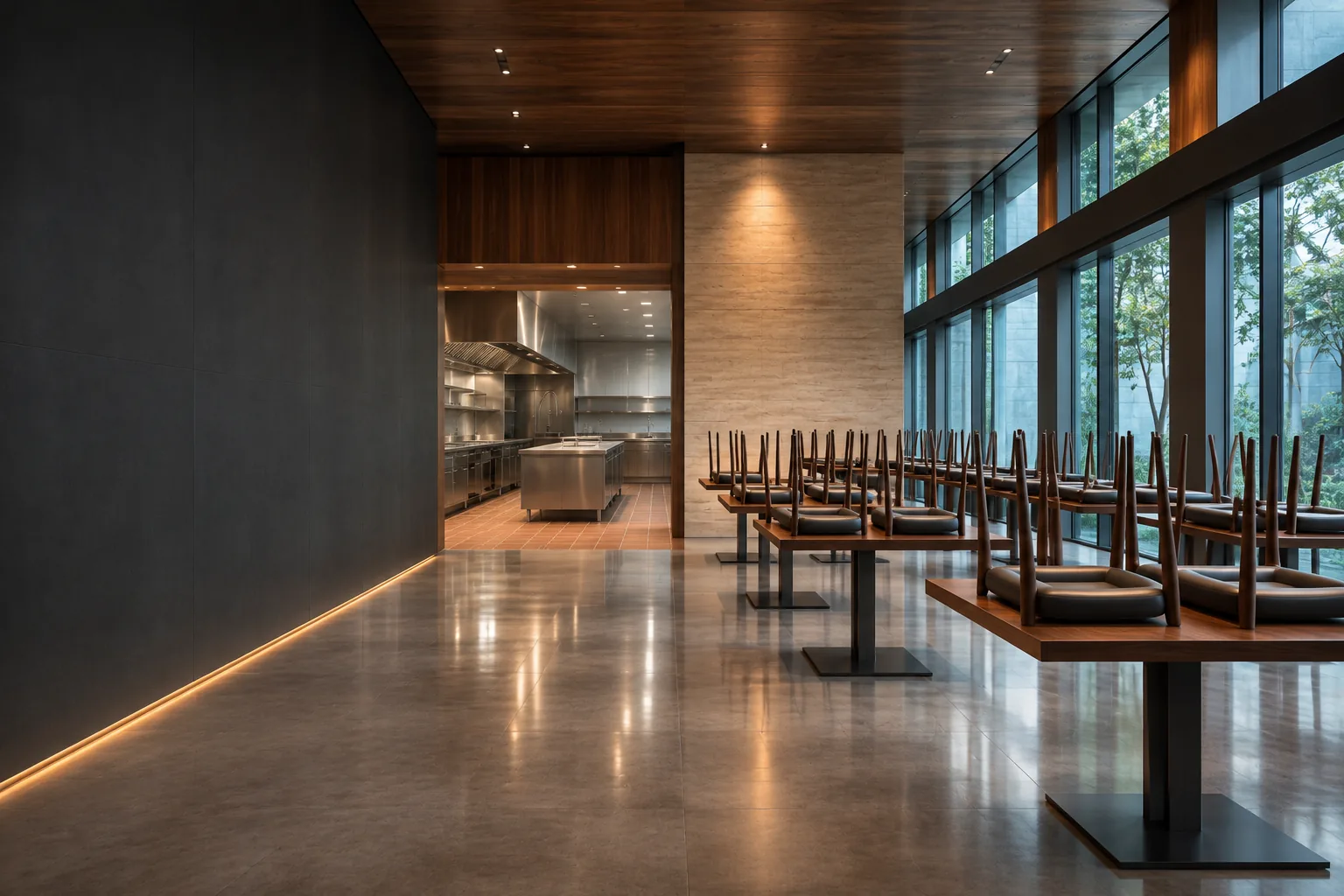
The floors an inspector reads first
A food facility’s floors fall into clear groups: the prep line and cook line, the dish room, walk-in coolers, dry storage, restrooms, the janitorial closet and the area where refuse waits for pickup. Each carries a different load of grease, water and traffic, and the California Retail Food Code treats most of them the same way.
The code is Part 7 of Division 104 of the Health and Safety Code, and county environmental health departments inspect against it. Before any method is chosen, we identify the material in each of those areas, its condition, the state of its grout and coving, and where water drains, the same starting point used across our restaurant and food-service floor care.
What section 114268 says about floor surfaces
Section 114268 lists the areas that need a specific kind of floor: wherever food is prepared, prepackaged or stored, where utensils are washed, where refuse is stored, where janitorial facilities sit, and every toilet and handwashing area. Those floors must be smooth, of durable construction and made of nonabsorbent material that is easily cleanable.
The code defines a smooth floor as an even or level surface with no roughness or projections that make it difficult to clean. Floors must also be coved where they meet the wall, with a minimum 3/8 inch radius running at least 4 inches up the wall. Areas holding only unopened bottles, cans, cartons, sacks or original shipping containers are the exception.
Two more details matter for cleaning. Sawdust, wood shavings and similar loose materials are prohibited outside dining and serving areas, and the section expressly allows approved sweeping compounds that hold dust down during cleaning, along with antislip floor finishes or materials where safety calls for them, a topic the slip resistance guide takes further.
Materials and how counties read the rule
Counties publish guidance on which materials meet section 114268. Sonoma County’s flooring guidelines, for example, list quarry tile with a coved tile base, with epoxy grout recommended, seamless troweled epoxy of at least 1/4 inch rather than paint, and homogeneous vinyl with heat-welded seams for full-service kitchens. Vinyl composition tile appears in that guidance only as a minimum for dry storage of prepackaged food.
Material choice is a construction decision, settled with the county before a floor goes in. Cleaning decides whether the floor stays smooth, nonabsorbent and easily cleanable after years of grease and hot water: open grout joints, a cracked cove or a worn spot in a coating gives soil a place to settle, and those are the defects worth reporting at the walkthrough.
For quarry tile and ceramic tile, deep scrubbing of the faces and joints is the core of the work, set out in the quarry tile kitchen floor guide.
Cleaning methods the code names
Section 114268.1 limits food facilities to dustless cleaning methods: wet cleaning, vacuum cleaning, mopping with treated dust mops, or sweeping with a broom and an approved compound that keeps dust from rising. Spills and drippage between normal cleanings can be spot-cleaned without that compound, and a liquid spill can take a small amount of absorbent applied just before it is wiped up.
The code also shapes the tools around the floor. Section 114279 calls for at least one curbed cleaning facility or janitorial sink with hot and cold water and a drain for mops and mop water, section 114281 calls for a separate room, area or cabinet for cleaning equipment, and section 114282 requires mops to be hung so they air-dry without soiling walls, equipment or supplies.
Equipment placement affects reach. Floor-mounted equipment that is hard to move must be sealed to the floor or raised on legs giving at least six inches of clearance, which leaves room to scrub underneath. Cleaners have to be kept in labeled containers and stored where they cannot drip onto food, equipment or linens, so chemicals for floor work never sit on a shelf above the prep line.
A floor cleaning plan that holds up at inspection
Section 114257 asks for all premises to be kept clean, fully operative and in good repair, and a floor plan turns that into a routine. Kitchen staff handle the daily wet cleaning and spill response with the dustless methods above. Periodic deep scrubbing reaches what daily mopping misses: grout lines, cove bases, the floor under equipment on legs and the area around floor drains and floor sinks.
Deep work belongs after close, with enough time for the floor to dry before morning prep, and each zone is scheduled on its own so the dish room or walk-in returns to service first. The kitchen degreasing plan covers the grease side of that routine, and the walkthrough sets the order of rooms, the method for each floor and the timing. Price and scheduling are confirmed before service.
A few useful answers
Quick answers.
Is VCT acceptable in a California restaurant kitchen?
Section 114268 requires smooth, durable, nonabsorbent and easily cleanable floors in prep areas, and county guidance such as Sonoma County’s lists VCT only as a minimum for dry storage. Confirm material with your county before installing.
What is the coving rule for food facility floors?
Floors must be coved where they meet the wall with at least a 3/8 inch radius, extending at least 4 inches up the wall, except where food is stored only in unopened original containers.
Which floor cleaning methods does the code allow?
Dustless methods: wet cleaning, vacuuming, treated dust mops, or a broom paired with a dust-holding sweeping compound. Spills between cleanings can be spot-cleaned directly.
Can a kitchen floor be deep cleaned overnight and used at opening?
Yes, when the work is scheduled with enough drying time before prep starts. Each zone is planned around its own closing and opening hours.
Industries
Related industries
Services